Buying guide · Weather
How to Choose a Waterproof Jacket
A good waterproof jacket is the most useful thing you can own for Irish weather. The trouble is that the labels are full of numbers and jargon, and two jackets that look identical on the rail can behave very differently in a downpour on the quays.
This guide explains what the terms mean, which ones matter for how you'll use the jacket, and how to look after it so it keeps working.
Waterproof, water-resistant and water-repellent
These three words are not interchangeable, and the difference is the first thing to check.
- Waterproof means the fabric itself stops water getting through, and the seams are sealed. It should keep you dry in sustained rain.
- Water-resistant (or "showerproof") means the fabric resists water for a while. It's fine for a short shower between car and shop, but steady rain will get through, usually first at the shoulders and seams.
- Water-repellent describes a surface treatment that makes rain bead and roll off. It's a finish, not a barrier. Waterproof jackets have it too, but on its own it won't keep you dry for long.
If you walk anywhere in Ireland for more than about 20 minutes on a regular basis, you want the first one. Jackets that only say "water-resistant" belong in the dry-day part of the wardrobe.
Hydrostatic head: how waterproof is waterproof
Waterproofness is usually given as a hydrostatic head figure in millimetres. It describes how tall a column of water the fabric can hold back before it leaks. The higher the number, the more pressure it can take.
As a rule of thumb:
- Around 5,000mm: light showers and short exposure. Fine for town and the car-to-office dash.
- Around 10,000mm: regular rain. A sensible minimum for daily walking, commuting and the school run.
- 20,000mm and above: heavy, sustained rain and long days out. Worth it for hillwalking in Kerry or Wicklow, or a long walk on the Wild Atlantic Way.
Pressure is what pushes water through, so sitting on a wet bench, kneeling, or carrying a heavy rucksack all increase it at those points. That's one reason a higher rating matters more for hillwalkers than for city walkers. Treat the numbers as a guide rather than a guarantee, as brands don't all test the same way, and a well-made jacket with sealed seams matters more than an extra few thousand millimetres.
Breathability, and why it matters on a humid Irish day
A jacket that keeps rain out also tends to keep sweat in. Breathability is the jacket's ability to let water vapour from your body escape. Without it, you get wet from the inside.
This is a bigger deal in Ireland than in colder climates. A typical wet day here might be 10 to 12°C with high humidity. Walk briskly to the bus in that and a non-breathable jacket will leave you clammy within minutes. Many people blame a leak when the real cause is condensation.
MVTR and RET
You'll see two ways of measuring breathability.
- MVTR (moisture vapour transmission rate) is given in g/m²/24h. Higher is more breathable.
- RET (resistance to evaporative heat transfer) works the other way round: lower is more breathable. Under 6 is very breathable, and the figure rises as breathability falls.
As with waterproof ratings, testing methods vary, so compare figures within a brand rather than between brands. If a jacket gives no breathability figure at all, assume it's modest.
Membranes and coatings
Waterproof fabrics get their protection in one of two ways.
Membranes are very thin films laminated to the back of the outer fabric. They have tiny pores, or a chemical structure, that block liquid water while letting vapour through. Gore-Tex and eVent are well-known examples, and many brands now use their own membranes. Membranes are generally more breathable and more durable.
Coatings are a waterproof layer, usually polyurethane, applied to the inside of the fabric. They're cheaper, lighter and perfectly waterproof when new, but they tend to be less breathable and can wear or peel with age. A coated jacket is a fair choice for occasional use or as a spare that lives in the car.
2-layer, 2.5-layer and 3-layer
The "layer" count describes how the jacket is built, not how many jackets you're wearing.
| Construction | How it's built | Good for |
|---|---|---|
| 2-layer | Outer fabric plus membrane, with a loose mesh or fabric lining | Everyday wear, commuting, town |
| 2.5-layer | Outer fabric plus membrane, with a thin printed inner coating | Packable spares, travel, occasional use |
| 3-layer | Outer fabric, membrane and inner fabric bonded into one | Hillwalking, heavy use, long wet days |
A 2-layer jacket feels soft and comfortable and is the usual choice for everyday rain jackets. The hanging lining adds a little weight and bulk. A 2.5-layer jacket is light and packs very small, which is ideal for a Ryanair carry-on or the bottom of a bag, but it can feel a bit clammy against bare arms. A 3-layer jacket is the most durable and usually the most breathable, but it's stiffer and costs more.
Seams: fully taped or critically taped
Every stitch hole is a potential leak, so waterproof jackets seal their seams with tape on the inside.
- Fully taped means every seam is sealed. This is what you want in a proper waterproof.
- Critically taped means only the seams most exposed to rain, usually shoulders, hood and upper body, are sealed. It's acceptable on a light shower jacket but not on one you'll rely on in steady rain.
Turn the jacket inside out in the shop. You should see narrow tape along the seams, including around the hood and across the shoulders.
DWR and re-proofing
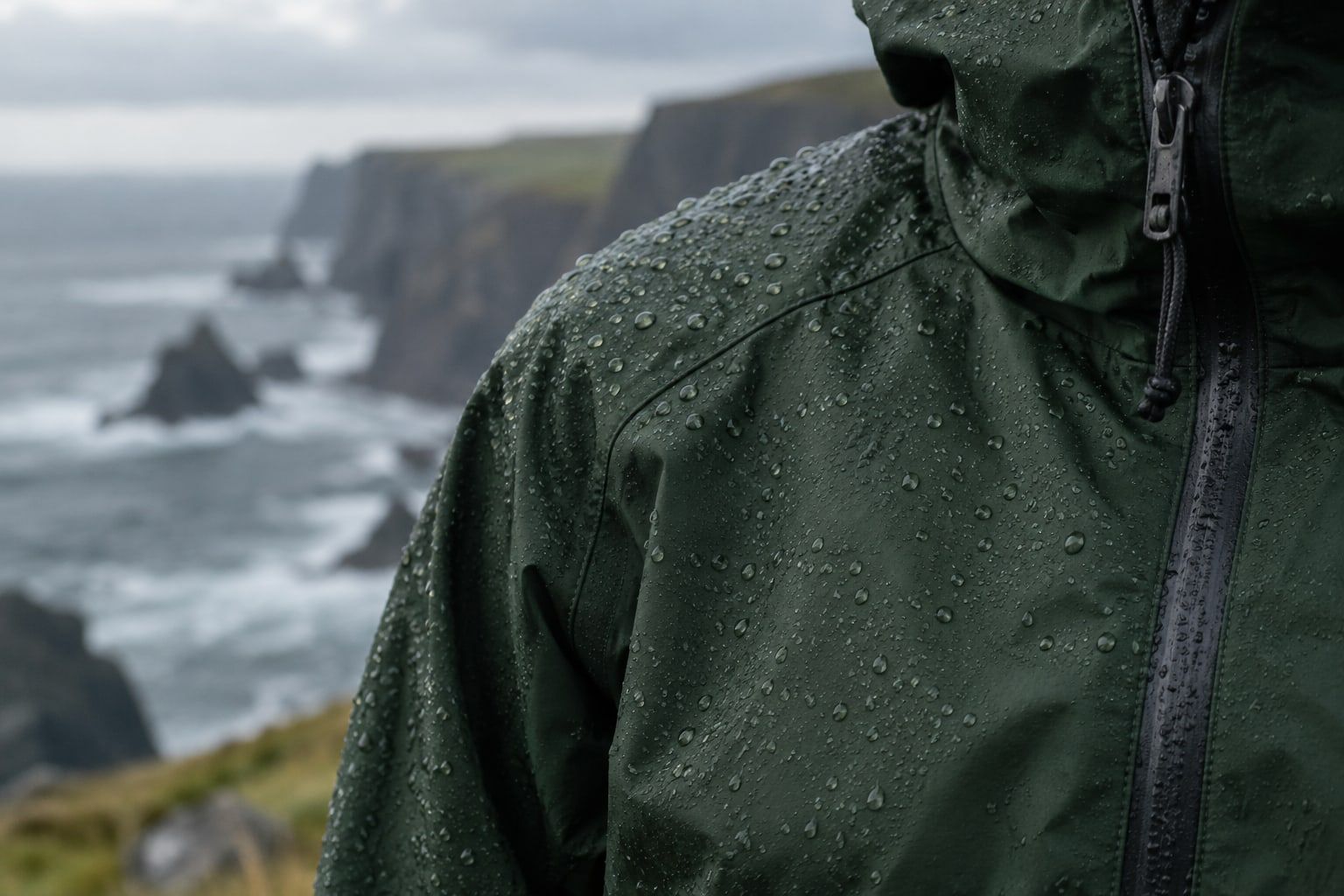
The outer fabric of a waterproof jacket has a durable water-repellent (DWR) finish that makes rain bead and roll off. When the DWR is working, the face fabric stays dry and the membrane can breathe. When it wears off, the outer fabric soaks up water, known as "wetting out". The jacket is still waterproof underneath, but it feels cold and heavy, breathability drops sharply, and you get damp from condensation.
DWR wears down with dirt, body oils, rucksack straps and time. The good news is that much of it can be restored.
The move to PFC-free DWR
Older DWR finishes used fluorocarbons (PFCs), which are very effective but persist in the environment. Most of the industry has moved, or is moving, to PFC-free finishes, and restrictions on these chemicals are tightening in Europe. PFC-free DWR works well when clean, but it's more easily affected by dirt and oils. In practice that means washing your jacket more often than you might expect, and re-proofing a bit sooner.
The details that keep rain out
The fabric is only half the story. On a wet, windy day in Galway, the small details are what keep you dry.
Hood
A good hood has a stiffened or wired peak to keep rain off your face, adjusters at the sides to close it around your face, and a volume adjuster at the back so it turns with your head. Try it on in the shop and look over your shoulder. If you're staring at the inside of the hood, it will be dangerous on a bike or crossing a road. Cyclists should check whether the hood fits over a helmet.
Zips and storm flaps
The front zip is a weak point. Look for either a water-resistant coated zip or a storm flap that covers the zip, ideally with an internal gutter behind it to catch anything that gets past. Pocket zips need the same protection, especially on chest pockets.
Cuffs
Adjustable cuffs, usually with a hook-and-loop tab, let you seal out rain and wind or loosen them to let heat out. Simple elasticated cuffs are fine for town but can't vent.
Hem and length
A hem drawcord stops wind blowing up the back. Length matters more than most people think: a jacket that covers your backside keeps rain from running off onto your trousers at the top of your thighs. Cyclists benefit from a dropped back hem.
Pit zips
Zips under the arms let heat and moisture out without opening the front to the rain. They're one of the most useful features for anyone who walks fast, cycles or hillwalks in humid Irish conditions.
Fit for layering
Buy your waterproof with the layers you'll wear under it in mind. In Ireland that's often a fleece or light puffer from October to March. Try the jacket on over a jumper or fleece, then lift your arms above your head and reach forward as if holding handlebars. The hem shouldn't ride up past your waist and the cuffs shouldn't pull back from your wrists.
Our fit guide on how much room to leave for layering covers this in detail, and why sizes differ between brands is useful if you're ordering online. European outdoor brands often cut slimmer than US brands, so always check the brand's own chart.
Caring for a waterproof jacket
Washing a waterproof jacket doesn't damage it. It's one of the best things you can do for it. Dirt, sweat and body oils clog the fabric and break down the DWR, and a clean jacket breathes better and beads rain again.
- Empty the pockets and close all zips and tabs.
- Use a technical wash, not normal detergent. Ordinary detergents and fabric softener leave residues that attract water.
- Wash on a gentle, cool cycle following the care label, and give it an extra rinse.
- Apply gentle heat to reactivate the DWR. A low tumble dry does this well, if the label allows it.
Drying without a tumble dryer
Plenty of Irish homes don't have a tumble dryer, and that's fine. Hang the jacket on a hanger indoors to dry, away from direct heat. Once it's dry, check the label: many jackets can be ironed on a low setting through a towel or cloth, which reactivates the DWR in the same way. A hairdryer on a warm setting, kept moving, also works on smaller areas like the shoulders and hood. Don't drape it directly on a radiator.
When to re-proof
If water still soaks into the outer fabric after washing and heat, it's time to re-proof. Spray-on proofers are easier to apply evenly to the outside than wash-in ones, and they don't coat the inner lining. Apply to a clean, damp jacket and follow with gentle heat if the product says so. Our guide to whether waterproofing sprays work covers re-proofing step by step.
What to look for, by use
| How you'll use it | What to prioritise |
|---|---|
| Short commutes and town | 2-layer, around 10,000mm, good hood, decent length |
| Walking to work or the school run | Fully taped seams, breathable membrane, adjustable cuffs |
| Cycling | High breathability, pit zips, helmet-compatible hood, dropped hem |
| Hillwalking | 3-layer, 20,000mm or more, pit zips, hood that fits over a hat |
| Spare for the car or bag | 2.5-layer, packs small, fully taped |
For more on matching a jacket to the conditions, see our guide to the best jackets for Irish weather, or browse the waterproof jackets section.